
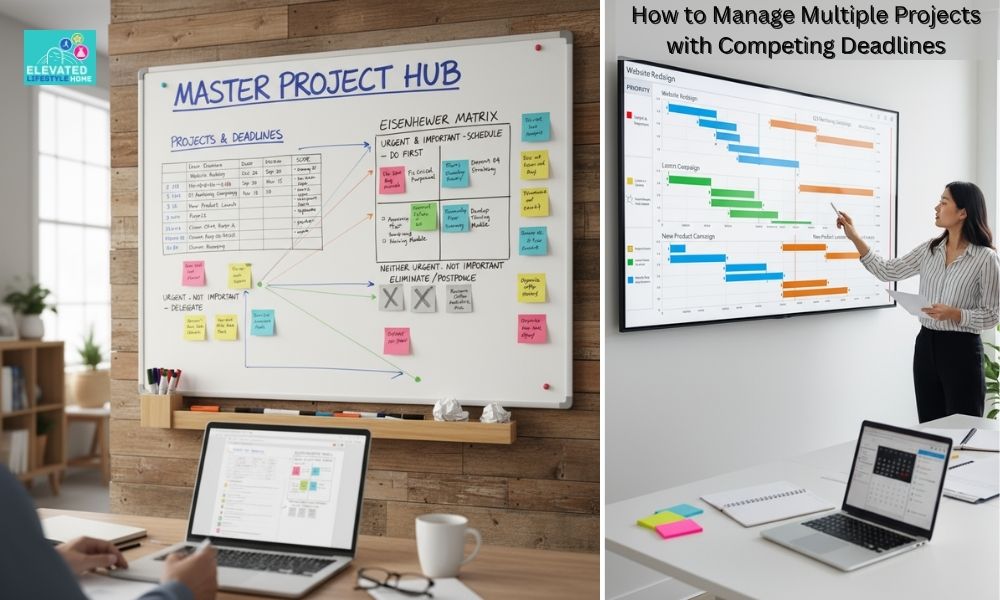
Most professionals do not struggle because they lack productivity. They struggle because they try to manage multiple projects without a clear prioritization system.
Learning how to manage multiple projects with competing deadlines starts with creating visibility, protecting focus, and building a system that helps you manage multiple tasks at work without feeling overwhelmed.
When deadlines overlap, and every project demands immediate attention, the pressure can feel paralyzing. Mastering the art of how to manage multiple projects with competing deadlines has evolved from a professional soft skill into a critical survival strategy for high-performance roles.
Whether you are navigating how to prioritize tasks in a fast-paced environment or searching for sustainable ways to manage multiple tasks at work, the solution lies in replacing frantic multitasking with structured systems.
Chaos transforms into measurable progress only when workflow optimization meets strategic intent. Ready to reclaim your calendar? Here are the proven frameworks to help you stay ahead of the curve.
Understanding the Chaos: What It Really Means to Handle Multiple Projects
Learning how to manage multiple projects with competing deadlines becomes difficult when cognitive overload leads to missed micro-deadlines, shifting priorities, and chronic workplace anxiety.
Effective multi-project management is not about how many balls you can keep in the air; it is about knowing which ones are glass and which are rubber.
Many professionals struggle because they attempt to navigate competing deadlines without a centralized command center.
Common project coordination challenges—such as scope creep, conflicting stakeholder meetings, and resource bottlenecks—often derail even the best intentions.
To overcome this, you must adopt a hybrid approach that merges resource allocation planning with agile workflow principles.
By creating a transparent project ecosystem, you reduce the unpredictability of daily operations and move toward sustainable output.
Why Managing Competing Deadlines Feels Overwhelming
Burnout is rarely a symptom of the workload itself; it is the result of “decision fatigue.” When your brain cannot distinguish between high-impact goals and busy work, stress levels spike.
The key to survival is goal alignment. Without a clear “North Star,” you are merely reacting to the loudest voice in the room.
When you integrate robust time allocation methods—such as Time Blocking or the Eisenhower Matrix—you create the mental space necessary for deep work.
Step 1 – Set Clear Priorities Before You Start Anything

The most common mistake is assuming all “urgent” tasks are equally important. Before opening your email, utilize formal project prioritization techniques to classify your deliverables based on long-term business impact.
Effective prioritization requires a shift from reactive tasking to outcome-based planning. When you evaluate your tasks through a rigorous framework, you stop managing emergencies and start managing milestones.
- Audit your pipeline: List every deliverable and map it against your quarterly OKRs.
- The Impact-Effort Matrix: Focus on tasks that offer the highest ROI with sustainable effort.
- Delegation: Identify tasks that do not require your specific expertise and offload them to improve team capacity.
Step 2 – Plan Like a Strategist, Not a Firefighter
A firefighter waits for the alarm to sound; a strategist builds the prevention system. To master smart project planning, you must move beyond the daily to-do list and start creating detailed milestones that account for human error and unforeseen risks.
Confidence replaces panic when you have a bird’s-eye view of your project portfolio. One of the most effective ways to manage multiple projects with competing deadlines is to visualize dependencies before they become bottlenecks.
Looking for the right tools? Review our list of top-rated Time Management Hacks That Instantly Boost Your Productivity
Step 3 – Build a Centralized System for All Projects

Managing multiple projects isn’t just about working harder; it’s about having a “Single Source of Truth.” When project data is scattered across emails, sticky notes, and spreadsheets, your cognitive load increases, leading to inevitable oversight.
A centralized system is the foundation of how to manage multiple projects effectively, ensuring that your team maintains a single source of truth.
- Why it works: Platforms like Asana, Trello, or Notion act as the backbone of your operations.
- Pro Tip: Use these tools to map out resource management workflows, ensuring that every stakeholder has visibility into project health and deadlines.
- Success Metric: Teams that centralize communication report a significant drop in “status-update” meetings, saving hours of productive time weekly.
Step 4 – Delegate, Collaborate, and Communicate Smartly
Strategic delegation is the antidote to manager burnout. You cannot be the bottleneck for every task. When you delegate, you aren’t just assigning work; you are empowering cross-functional teams to own their outcomes.
- The Logic: Clear communication minimizes overlap. When roles are defined via effective delegation techniques, bottlenecks disappear.
- Focus Area: Use daily brief “stand-ups” to keep accountability high without micromanagement.
- Result: When you foster a culture of transparency, you naturally manage stakeholder expectations more effectively.
Step 5 – Stay Flexible When Plans Change
Reality rarely aligns perfectly with a project roadmap. In a complex project environment, change is not a failure—it is a data point. The goal is to build a system that absorbs volatility without sacrificing delivery quality.
- Adaptability Framework: Maintain a “buffer zone” in your schedules to handle last-minute adjustments without compromising quality.
- Outcome-Oriented Mindset: Skilled managers distinguish between the process and the objective. If a specific task is no longer serving the end goal due to a change, be prepared to pivot your resources immediately.
Step 6 – Use Smart Techniques to Manage Multiple Tasks at Work

Efficiency is not about doing everything; it is about doing the right things. When you manage multiple workflows, your ability to prioritize is your most valuable asset.
- Prioritization Tactics: Use the Eisenhower Matrix to filter out “urgent but unimportant” tasks. Adopt Time Blocking to group related tasks—this reduces the cognitive cost of switching between deep-focus work and administrative emails.
- Workflow Optimization: Utilize tools like Todoist or Trello to maintain a visual board of high-impact deliverables, keeping your focus on the “critical path.”
Step 7 – Embrace Technology and Automation

Manual data management is a tax on your team’s creativity. Modern project management requires moving away from spreadsheet-heavy manual tracking and toward automated ecosystems.
If you are serious about how to manage multiple projects, you must leverage automation tools like Zapier to handle routine status updates.
- Leverage Integration: Use Zapier or native tool integrations to connect your communication (Slack/Teams) with your task management software. This ensures that updates are pushed automatically, removing the need for manual status reports.
- Focus on High-Level Decision Making: By automating repetitive notifications and recurring status updates, you free up hours for genuine team strategy and problem-solving.
Step 8 – Manage Your Energy, Not Just Your Time
Time is a finite resource, but energy is renewable. Operating under the illusion that you can maintain peak output for 12 hours straight is a recipe for burnout and cognitive decline.
Burnout isn’t just about workload—it’s about energy management. Learn more in our post: Mindful Task Management for High Performance Daily Habits
- The Strategy: Align your most complex, high-stakes tasks—such as technical SEO audits or strategy development—with your peak energy hours.
- The “Deep Work” Protocol: Implement uninterrupted blocks of 90–120 minutes dedicated to high-impact work. Follow these with intentional, non-negotiable recovery periods to reset cognitive load.
- Sustainability: Encourage “deep work” sessions followed by intentional rest. Consistent productivity is the result of balance, not constant motion.
Step 9 – Review, Reflect, and Recalibrate Weekly
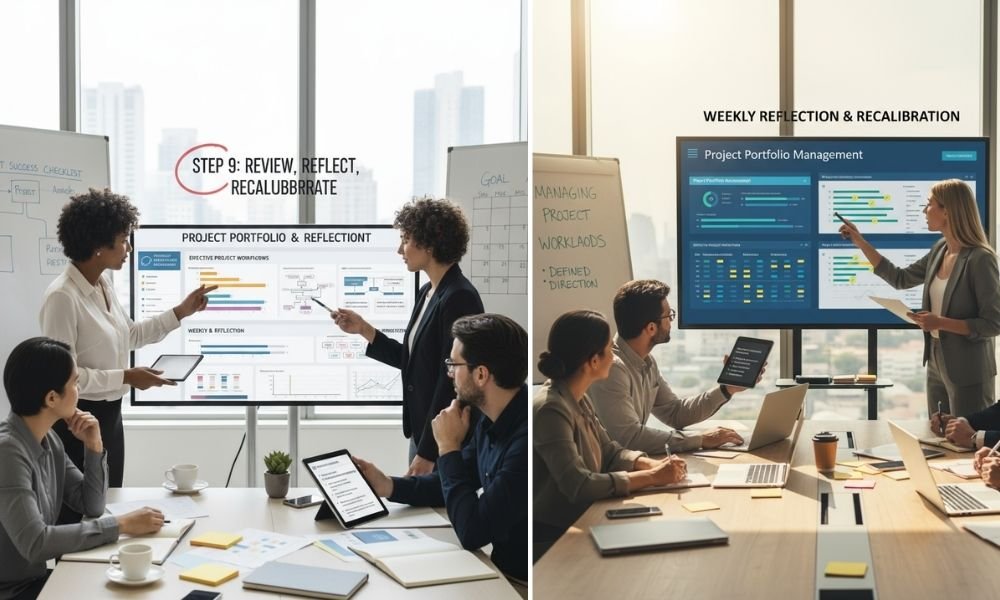
A project that lacks a feedback loop is a project that is drifting toward failure. Weekly retrospectives act as a “forensic checkpoint” to catch inefficiencies before they escalate.
- The Weekly Reflection Audit: Dedicate 30 minutes every Friday to evaluate your project velocity against your KPIs. Use this time to identify which tasks were “noise” and which drove real results.
- Proactive Recalibration: If a project is lagging, don’t wait for a deadline to fail. Use your Friday audit to adjust timelines, re-prioritize pending tasks, and address resource constraints for the upcoming week.
- Strategic Shift: This practice moves your team from “reactive firefighting”—where you are constantly fixing immediate issues—to “proactive growth,” where you stay ahead of the curve.
Step 10 – Real-Life Tips for Managing Multiple Projects Simultaneously
Managing competing deadlines is as much about human intuition as it is about rigid systems. You need a set of heuristics that allow you to make high-stakes decisions under pressure.
- The “Rule of Three”: Every morning, define exactly three non-negotiable targets for the day. This creates a psychological “North Star,” preventing you from getting lost in lower-value administrative work.
- Resource Elasticity: When you hit maximum capacity, do not sacrifice project quality. Instead, use resource allocation strategies to shift workloads. Identify which projects can be deprioritized or delegated without impacting the overall project portfolio.
- Decision Heuristics: When two deadlines collide, use an “Impact-First” filter: Which project, if left unfinished, would cause the greatest long-term damage? Protect that project at all costs.
| Challenge | Solution | Benefit |
| Too many deadlines | Time-blocking | Clarity & focus |
| Poor communication | Centralized Project Hub | Reduced confusion |
| Resource limits | Load balancing | Balanced team output |
Final Thoughts: Turning Chaos into Calm
Mastering the art of managing multiple projects with competing deadlines is not about juggling tasks—it is about architecting a predictable workflow.
When you move from reactive ‘task-chasing’ to strategic ‘capacity planning,’ the chaos of high-pressure environments dissolves into streamlined productivity.
By applying robust project management frameworks and prioritizing tasks through impact-weighted analysis, you convert professional pressure into measurable progress. Your workflow is no longer a hurdle; it is your competitive advantage.
Ready to improve your workflow even further? Explore our complete guide to time blocking and productivity systems to build a more organized workday.
FAQs: How to Manage Multiple Projects with Competing Deadlines
1. How can multiple projects be prioritized effectively?
Prioritization starts by assessing the impact of each project against your overall business goals. Use a framework like the MoSCoW method (Must have, Should have, Could have, Won’t have) to filter out noise and focus on high-impact deliverables first.
2. What is the best way to handle competing deadlines?
The key is to create a master timeline that visualizes dependencies. By mapping out exactly when each milestone occurs, you can identify potential bottlenecks early and proactively adjust your schedule to avoid last-minute crises.
3. How can project workloads be managed efficiently?
Efficiency is achieved through proper resource allocation. By understanding your team’s capacity and using resource management software, you can distribute work evenly, ensuring no single person becomes a point of failure.
4. Which tools are recommended for tracking multiple projects?
For enterprise-level clarity, use platforms like Asana, Monday.com, or Jira. These tools centralize communication, automate progress reporting, and help you keep a pulse on real-time project health without constant status meetings.
5. How can team productivity be improved under pressure?
Under pressure, clarity is the best remedy. Empower your team by defining clear ownership for every sub-task and keeping communication lines open. When people understand their specific contribution to the bigger picture, focus improves.
6. How can limited resources be allocated effectively?
Start by identifying critical path tasks—the activities that, if delayed, will push back the entire project completion date. Align your best resources with these tasks to ensure that your most constrained assets are working on the highest-value problems.
7. What strategies help prevent burnout while managing multiple projects?
Burnout often stems from a lack of boundaries. Implement “Deep Work” blocks where you focus solely on complex tasks, and ensure your workflow includes regular, non-negotiable breaks. Balancing project intensity with recovery periods is essential for long-term output.
8. How can stakeholder conflicts be handled efficiently?
Transparency is your strongest tool. If priorities must change, communicate the “why” to stakeholders early. By managing expectations through regular, data-backed updates, you minimize friction and maintain professional trust.
9. What are the best practices for managing multiple priorities?
Always start your day with a “Top 3” list of must-do items. Weekly reviews are equally important; take time every Friday to evaluate the progress of the past week and refine the plan for the upcoming week based on new developments.
10. How can real-time progress across projects be monitored?
Utilize automated dashboards within your project scheduling software. These provide visual insights into KPIs, helping you spot delays or resource gaps before they escalate into project-killing issues.

