
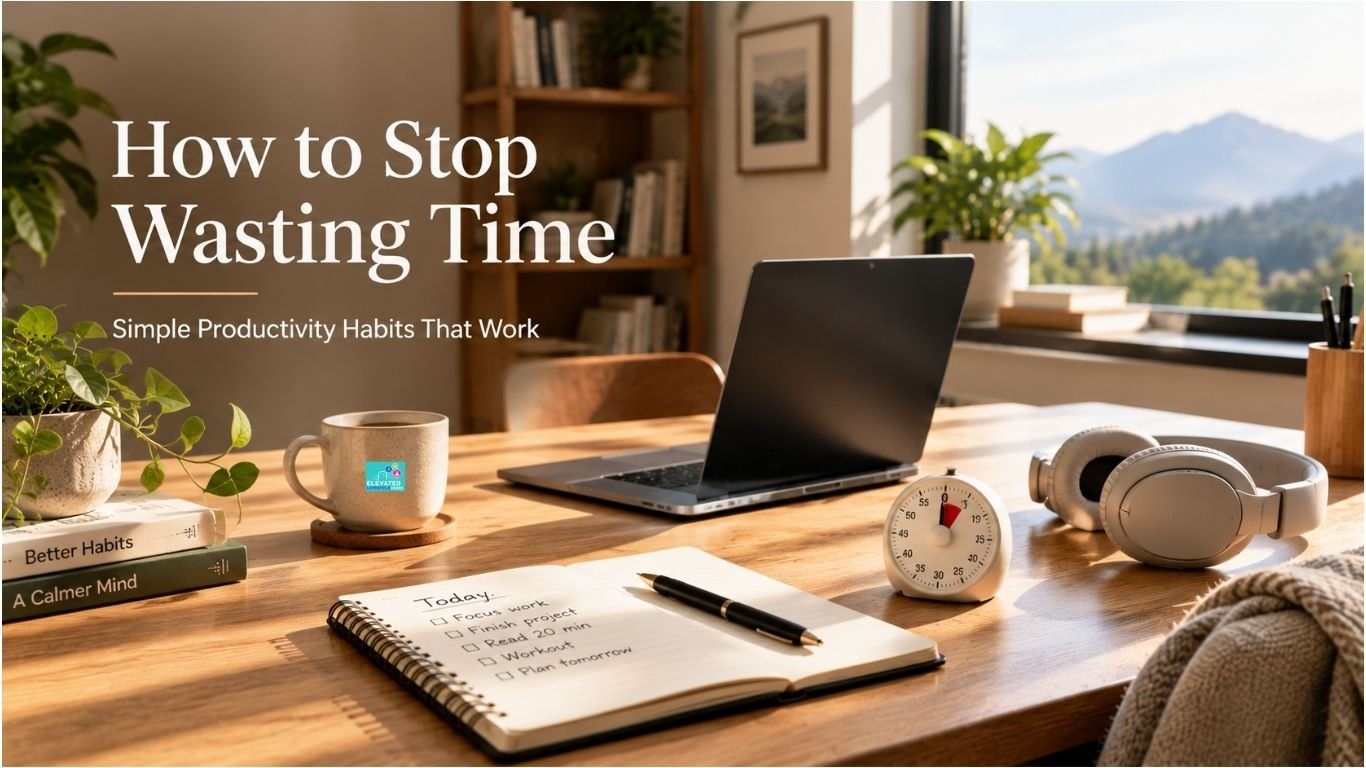
We often reach the end of a busy day wondering where the hours went. Learning how to stop wasting time at work is not about filling your schedule with more tasks. It is about identifying low-value activities, reducing distractions, and giving your most important work more focused attention.
Simple habits such as time blocking, single-tasking, reducing digital distractions, and creating a focused workspace can make your day easier to manage without turning productivity into another source of stress.
In this guide, you will learn practical ways to protect your attention, organize your time, and get more meaningful work done without constantly feeling busy.
Affiliate Disclosure: This post contains affiliate links. If you purchase through one of these links, we may earn a commission at no additional cost to you.
As an Amazon Associate I earn from qualifying purchases.
Why You Keep Wasting Time at Work
Time is limited, so repeatedly losing small blocks of it to scrolling, unnecessary emails, notifications, or low-value tasks can quickly add up. The problem is not always how much work you have, but how often your attention gets pulled away from what matters most.
Once you recognize how much mental energy constant interruptions can consume, protecting your attention becomes much easier to prioritize.
Why We Waste Time: The Psychology of Modern Distraction
Our brains are naturally wired to seek out novelty, which makes the modern digital landscape particularly challenging for sustained focus.
We often fall into procrastination habits not because we are lazy, but because we are seeking a temporary escape from stress or boredom.
Understanding that your phone is designed to capture your attention is the first step toward reclaiming it. I’ve realized that acknowledging the “itch” to check an app is often more effective than simply trying to use willpower to ignore it.
I used to think I was “resting” by scrolling through social media, only to realize my brain felt more exhausted afterward than before I started.
Define Your North Star: Setting Intentional Priorities

Without a clear vision of what matters, every distraction feels like a valid way to spend time. Setting a “North Star” means identifying the three most important goals for your day before you even open your laptop.
This simple act of mindful productivity filters out the “busy work” that masquerades as progress. When you know exactly what you want to achieve, it becomes easier to say no to low-value distractions.
Writing down your top three priorities before opening your inbox can help prevent non-urgent emails and small tasks from taking over the morning.
Master Your Environment: Designing a Space for Deep Work
Your physical surroundings can influence how easy it is to stay focused. A cluttered desk can make it harder to focus, especially when notifications, paperwork, and unrelated items compete for your attention.
To make focused work easier, keep your workspace as free from visual and auditory distractions as possible. A clean, minimalist workspace can make it easier to keep your attention on the task in front of you.
One simple way to reduce interruptions is to keep your phone in another room during focused work sessions.
When you cannot control the noise around you, reducing background interruptions can make focused work easier. Noise-cancelling headphones (paid link) can help limit conversations, traffic, or household noise during demanding work sessions.
Focus is only the beginning of an intentional life. Once your mind is clear, your surroundings should follow. Explore our guide on A Complete Guide to Digital Decluttering.
The Art of Time Blocking: A Minimalist Schedule

Time blocking is the practice of assigning specific periods of time to specific tasks. By planning these blocks in advance, you reduce the decision-making that often leads to wasted time between projects.
A simple Pomodoro timer (paid link) can make time-blocking easier without adding another app or notification to your workspace. Set it for the length of your focus session, put your phone aside, and work until the session ends.
This method isn’t about being rigid; it’s about being honest with how much you can actually accomplish. A well-designed block of time gives you enough uninterrupted time to focus on one task and make steady progress.
When I started blocking 90 minutes for focused work without internet access, I found it easier to stay with one task and avoid unnecessary browsing.
Digital Minimalism: How to Avoid Digital Distractions Daily

One of the biggest barriers to focused work is the constant stream of digital distractions competing for our attention. To truly learn how to avoid digital distractions, we must move beyond temporary “detoxes” and adopt a lifestyle of digital minimalism.
This means intentionally choosing which tools are useful and removing those that add unnecessary digital clutter.
By setting strict digital boundaries at home, you create a calmer environment with fewer unnecessary interruptions. I have found that turning off all non-human notifications—leaving only calls and texts—drastically reduces the urge to constantly check my device.
This shift allows you to focus on the person in front of you or the project at hand without constantly checking for another social media alert.
If you find yourself mindlessly reaching for your phone, try the “Three-Breath Rule”: take three slow breaths before unlocking it to see if you actually need the device or are just seeking a distraction.
I challenge you to a 24-hour digital fast: turn off all non-human notifications starting now. Embrace the quieter environment and notice whether it becomes easier to stay focused without constant notifications.
Stop Multitasking: Why Single-Tasking is a Superpower
What we call multitasking is often rapid task switching, which can make focused work slower and more error-prone. When you stop multitasking, you reduce unnecessary task switching and give each activity more focused attention.
Focusing on one task at a time gives you more space to work carefully without constantly switching your attention.
Understanding the benefits of a mono-tasking workflow can make it easier to stay focused and complete demanding tasks.
When I commit to one task at a time—whether I’m writing, researching, or completing an important work assignment—the quality of my work improves, and I finish with fewer distractions.
It turns a chore into a more focused and manageable experience, making it easier to stay engaged with the task in front of you.
I’ve discovered that when I close all browser tabs except the one I’m currently using, I finish my research in half the time it used to take.
Common Pitfalls: Why Most Productivity Systems Fail
Many people struggle with how to stop wasting time because they build productivity systems that are too complicated to maintain.
We often get caught up in the aesthetics of productivity—the perfect planner or the newest app—rather than the actual work that matters most.
Over-complicating your process is just another sophisticated form of procrastination that keeps you from your goals. The key is to keep your system as minimalist as possible. If a habit takes more energy to track than it does to execute, it isn’t serving you.
I’ve learned that the best systems are invisible; they should support your life without becoming a burden themselves. Focus on the core habits of mindful productivity rather than the tools used to measure them.
How to Overcome the Midday Slump and Protect Your Focus
Focus is not just a mental discipline; it is a physical one. Learning how to avoid distractions and stay focused requires an honest look at your energy levels throughout the day.
Instead of forcing yourself to work through a slump, try an “energy reset” through movement or a brief break to clear the mental fog. Matching demanding tasks to your peak energy periods can make it easier to protect your focus throughout the day.
For many, this is the morning, but for others, it may be late afternoon. I have found that a 10-minute walk without my phone is more effective for my focus than a third cup of coffee. It’s about listening to your body’s natural rhythms to maintain the best energy.
If I feel my focus dipping at 2:00 PM, I step away for a quick stretch rather than trying to power through, which usually results in “junk work.”
How to Stop Wasting Time Online
To learn how to stop wasting time online, treat your attention like a limited resource. The “attention economy” is designed to keep you scrolling, but you can take back control of your online attention by using tools that block distracting sites during work hours.
The goal is to make distracting websites and apps less convenient to access while keeping the tools you actually need easy to reach. When you practice eliminating low-value tasks in your digital life, you create more room for meaningful work.
I’ve realized that much of our online time is spent in a reactive state—replying to messages or following links. By becoming proactive and setting specific “online windows,” you ensure that the internet remains a tool for your benefit rather than a drain on your life.
I use a browser extension to hide my social media feeds, so I can still use the platforms for business without getting sucked into an endless cycle of content.
Essential Tools for a Focused Mind
While minimalism is the goal, a few well-chosen tools can support your efforts to stop wasting time at work. Look for tools that encourage a deep work philosophy rather than those that offer endless features.
A few simple tools can support a focused work environment without adding more complexity. The goal is to choose tools that help you stay with the task rather than giving you another system to manage.
A physical distraction pad (paid link) can be useful for jotting down random thoughts, reminders, or unrelated tasks while you work. Writing them down gives you a place to return to later without interrupting the task in front of you.
The best tools are those that fade into the background. Choose simple tools that support your workflow without adding another system to manage.
I believe that an elevated home office should feel like a sanctuary, equipped with only the essentials that promote a sense of calm and purpose.
Cultivating Longevity in Your Focus Habits

Sustainable productivity is a marathon, not a sprint. To truly understand how to stop wasting time, you must forgive yourself for the days when you slip up. The goal is not perfection, but a consistent return to your center.
By building a morning routine for focus, you create a foundation that can weather the occasional distraction or busy season.
As these habits become part of your routine, you may find it easier to protect time for work, family, creativity, and rest.
The goal is not to eliminate every unproductive moment, but to spend more of your time on the things that matter to you. Trust the process, stay mindful, and enjoy the clarity that follows.
This evening, take a moment of stillness to reflect: What is one task you want to finish tomorrow before the small distractions take over? Share it in the comments below.
FAQs: How to Stop Wasting Time at Work
What is the easiest way to stop wasting time?
The most effective way is to practice single-tasking. Instead of juggling multiple responsibilities, focus entirely on one task until it is finished. This reduces mental fatigue and prevents the “context switching” that kills productivity.
How do I stop procrastinating and get things done?
To overcome procrastination, use the “5-Minute Rule.” Commit to working on a difficult or boring task for just five minutes. Often, the anxiety of starting is the biggest hurdle; once you begin, momentum naturally builds.
Why do I feel like I’m wasting my day?
This feeling usually stems from a lack of clear goals and “decision fatigue.” When your day is unorganized, you may spend more time deciding what to do next, which can leave you feeling tired without making much progress.
What are the best time management techniques for beginners?
Beginners should start with time-blocking. Assign specific windows of time to specific tasks rather than working from a vague to-do list. This creates a clear structure and prevents low-value work from filling your day.
How can I be more productive at home?
Productivity at home requires a dedicated workspace. Even if you don’t have an office, designate a specific spot only for work. This helps your brain distinguish between professional time and rest time, improving focus.
Does multitasking actually save time?
Constantly switching between tasks does not necessarily save time. It can increase mental switching costs, make mistakes more likely, and make focused work harder. This repeated context switching can make work feel slower, increase the chance of mistakes, and make it harder to maintain focus.
How do I prioritize my daily tasks?
Use the “North Star” method. Before starting your day, identify your top three high-impact goals. If a task doesn’t move you closer to these three objectives, consider it “busy work” and either delegate or eliminate it.
What is digital minimalism?
Digital minimalism is the intentional practice of using technology only for tasks that add value to your life. It involves disabling all non-human notifications, clearing your desktop, and setting specific windows for email and social media.
How can I manage my energy throughout the day?
Manage your energy by matching demanding tasks to the times of day when you naturally feel most alert. Schedule your most complex, high-impact work during your peak hours of mental clarity (usually the morning) and save routine administrative tasks for your afternoon “slump.”
How do I stop scrolling on my phone?
Use the “Three-Breath Rule.” Whenever you reach for your phone, take three slow breaths first. This short pause can interrupt the automatic urge to check your phone and give you a moment to decide whether you actually need it.
