
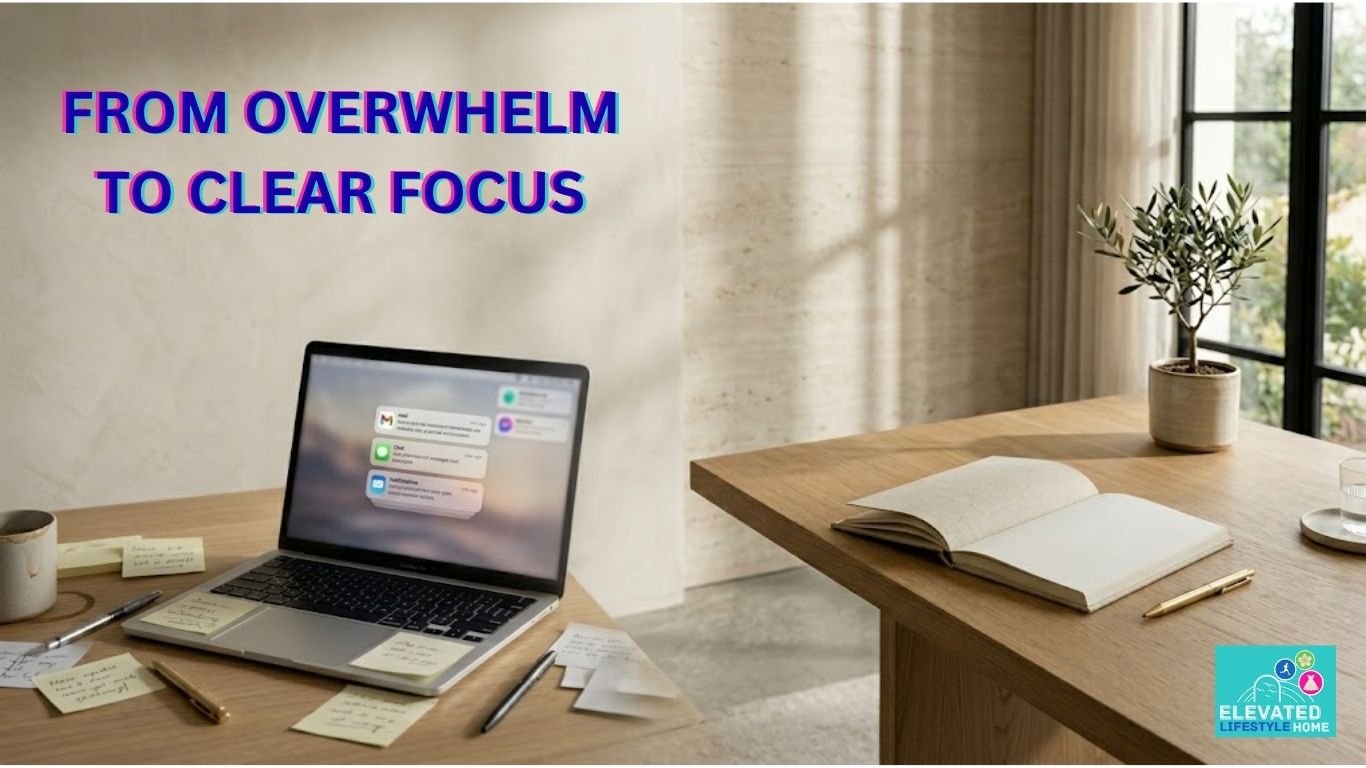
Why Overwhelm Makes It Hard to Focus
Feeling overwhelmed is not always about having too much work. Sometimes it comes from having too many tasks, decisions, messages, and expectations competing for your attention at the same time.
If you’re wondering how to focus when overwhelmed, the first step is to stop treating every task as equally urgent.
When you normally get things done quickly, feeling stuck can be frustrating. You know you have work to do, but you cannot seem to decide what to tackle first.
The problem gets worse when everything is treated as equally important. Emails, messages, deadlines, and bigger goals can all start competing for your attention at once.
Disclosure: As an Amazon Associate I earn from qualifying purchases. Some links in this article are paid affiliate links, which means I may earn a commission if you make a qualifying purchase, at no additional cost to you.
Why Stress Makes It Hard to Think Clearly
When stress gets high, it becomes harder to think clearly and decide what to do next. When stress builds up, even a normal inbox can start to feel urgent. That pressure can make it harder to slow down, prioritize clearly, and decide what actually needs your attention first.
When stress gets high, it becomes harder to think clearly and solve problems. You fluctuate between frantic multitasking and total avoidance.
Why Conventional Productivity Fails High Achievers
Generic time-management frameworks often exacerbate the problem by adding more administration to an already exhausted mind.
Tracking every minute in a complex app introduces friction when you least afford it. When you’re already overwhelmed, adding another complicated tracking system can make things worse. What helps more is having fewer things to deal with at once.
How to Focus When Overwhelmed: A Simple Reset
When you are drowning in competing priorities, trying to power through is a losing strategy. Knowing how to focus when overwhelmed starts with taking a short pause before trying to fix everything at once.
Even smart people make terrible decisions when their nervous system is overloaded. The goal is simple: calm things down before trying to solve everything.
The first step is simply to slow things down so you can see what actually needs to be done. Try this simple two-step reset. It only takes a few minutes but can help you approach the next task with a clearer head.
📝 Quick Takeaway: When paralysis sets in, stop typing immediately. Shift your vision away from the screen, lengthen your exhale to drop your heart rate, and isolate exactly one single action item. Everything else is background noise.
The 90-Second Cortisol Downshift
To break the physiological grip of stress, sit back from your desk. Inhale deeply through your nose, then take a second short sip of air to expand your lungs fully.
Exhale slowly through your mouth. Try taking a slow breath in through your nose and then breathing out slowly through your mouth. The goal is simply to pause, slow your breathing, and give yourself a moment before jumping back into the next task.
How to Decide What Matters First
Once calm, open a blank notebook. Write down the absolute worst-case scenario if something drops today.
Most things feel urgent until you force yourself to define the actual consequence. Select exactly one task that directly mitigates that specific scenario. Everything else gets pushed to tomorrow.
A simple notebook can give you a place to write down your priorities before starting work.
View a lined notebook on Amazon (paid link)Designing the Environmental Anchor: How to Set Up a Minimalist Workspace

Your workspace can affect how easy or difficult it feels to concentrate. A cluttered desk continually triggers subconscious processing, draining the mental reserves needed for complex problem-solving.
A minimalist workspace is really about removing things that compete for your attention. I still remember looking at my desk one afternoon and feeling irritated before I had even started working. Open cables. Random notes.
Half-finished coffee. Nothing dramatic. Just visual noise everywhere. Once I cleared the space and reduced what stayed in my line of sight, focusing stopped feeling so mentally expensive.
- The Desktop Edit: Keep only three items on your immediate work surface: your primary computer, a simple notebook, and a single writing instrument.
- Clean Up Your Cables: Conceal all power bricks and cables beneath the desk surface using sleek routing trays.
- The Lighting Reset: Position your desk near natural, indirect morning light to maintain optimal circadian alignment and mental clarity.
If your phone keeps moving around your desk, a simple phone stand can give it a fixed place and keep it away from your main work area.
View the phone stand on Amazon (paid link)
Why a Physical Notebook Can Help
High-quality, physical materials ground your attention. A physical notebook can also give you a simple place to capture thoughts without opening another app or creating another digital distraction. Using a physical notebook can also make it easier to sit down and focus without opening another app.
Removing Visual Noise for Uninterrupted Deep Work
Too many things on your desk can make the space feel distracting, especially when you are already trying to concentrate. Remove sticky notes, redundant tech gadgets, and unread books from your line of sight.
By storing these items in closed drawers, you minimize peripheral micro-distractions and allow your eyes to rest peacefully on your primary task.
A small desk organizer can keep pens, notes, cables, and other everyday items from spreading across your main work surface.
View the desk organizer on Amazon (paid link)If your desk still feels visually busy, these desk organization ideas for productivity can help you create a cleaner setup without making the space feel sterile.
Dealing with Distractions While Working from Home

Working from home gives you flexibility, but it can also create a lot of small distractions. Dealing with distractions while working from home requires more than just willpower; it demands clear physical and practical boundaries
Without these, the boundary between professional urgency and domestic comfort completely dissolves. The real problem is rarely one major interruption.
It is the constant drip of small distractions that quietly break your concentration all day long. To protect your work performance, you must treat your home office with the same institutional respect as a corporate boardroom.
If your environment constantly pulls your attention in ten different directions, a distraction-free home office setup can quietly change the way you work.
The Psychology of Domestic Interruption
Your brain associates home environments with relaxation and family dynamics. When you attempt deep work in these spaces without an explicit shift in context, it can be harder to switch into work mode. Your mind remains partially attuned to household demands, which dramatically reduces your depth of focus.
Creating Physical Boundaries in Shared Spaces
A closed door is a non-negotiable boundary. If a dedicated room is not an option, use a minimalist room divider or a designated heavy oak desk facing away from common areas.
Communicate your deep-work hours clearly to anyone sharing your space, establishing that a closed door means absolute unavailability.
A Simple Focus Routine You Can Try
When cognitive fatigue sets in, relying on raw inspiration is a recipe for failure. A simple routine can make it easier to get started without thinking about every little decision.
Knowing how to build a focus routine means establishing a simple routine that removes decision-making from your early hours. To ensure your day opens with this exact precision, mastering how to build a morning routine serves as your foundational first step.
To counter this, I developed the My Three-Step Focus Routine—a three-stage daily architecture designed specifically to protect the cognitive reserves of high achievers.
The goal is simple: reduce the number of decisions your brain needs to make before deep work begins. The idea is to make your routine simple enough that you don’t have to keep deciding what to do next.
By standardizing how you enter, navigate, and exit your workday, you eliminate the mental friction that leads directly to procrastination.
Phase 1: The Morning Anchoring Ritual
Spend the first twenty minutes of your day completely offline. Sit at your light oak desk with a warm beverage and a physical notebook. Write down your primary objective for the day.
This simple, analogue grounding practice shields your brain from the reactive, dopamine-driven state triggered by checking emails first thing in the morning.
Step 2: Choose One Focused Work Block
Dedicate a single, 90-minute window to your most complex strategic goal. Turn off all messaging apps, place your phone in another room, and work in absolute silence.
Choose a focused work block that feels realistic for you. For some people, 60–90 minutes works well; others may need shorter sessions with a brief break in between.
Step 3: Step Away for a Few Minutes
At the end of the block, close your laptop and step completely away from your workspace. Spend ten minutes engaged in a low-stimulation activity—walk around the block or gaze out the window.
When the work block ends, step away for a few minutes. A short walk, stretch, or quiet break can help you return to your next task feeling less mentally crowded.
Common Pitfalls: The Mistakes That Fuel Cognitive Fatigue

Many professionals inadvertently sabotage their own focus through hidden behavioral loops. They assume they are simply working hard, but in reality, they are burning precious cognitive energy on low-value tasks.
We often glorify the hustle, yet true high performers are intensely protective of their energy.
If you constantly find yourself exhausted yet feeling like you achieved nothing substantive by 5:00 PM, you are likely falling into design flaws that require learning how to fix a broken daily routine before your momentum permanently stalls.
The Illusion of Multitasking Efficiency
Switching rapidly between an Excel spreadsheet, a Slack thread, and a text message feels productive, but it introduces a severe penalty known as attention residue.
A portion of your focus remains locked on the previous task, meaning you are never operating at full mental capacity on your primary project.
Over-Scheduling the Recovery Windows
An executive calendar packed back-to-back with zero breathing room is structurally flawed. True cognitive recovery cannot be forced into a frantic five-minute gap between Zoom calls.
Without open, unscheduled white space in your schedule, your brain remains in a constant state of low-grade anxiety, destroying your capacity for creative insight.
Advanced Focus Strategies for Work Performance
Staying focused over the long term is less about squeezing more work into the day and more about protecting your attention.
It is about treating your mind like a fine-tuned engine that requires precise inputs, intentional maintenance, and structured downtime.
QUICK SUMMARY: Time is finite, but attention is expandable. Protect your focus by treating your energy as a premium resource. Use physiological pauses to recharge
and reset your cognitive clock throughout the afternoon.
Instead of trying to squeeze more hours out of your day, focus on maximizing the intensity and purity of the hours you already have. This is how top-tier performers manage heavy workloads without burning out or sacrificing their mental clarity.
- Radical Monotasking: Isolate a single variable and work on it until it is finished or your time block ends. No secondary tabs, no quick notification checks.
- Non-Sleep Deep Rest (NSDR): Implement a 10-minute NSDR protocol or protocol-based breathing mid-afternoon to rapidly restore your nervous system’s processing capacity without taking a full nap.
- Environmental Scent Anchors: Utilize a premium, natural scent—such as Hinoki wood or subtle sandalwood—exclusively during deep work blocks to chemically signal to your brain that it is time to concentrate.
Focus on Attention, Not Just Time
Time management asks how much you can fit into a day; attention management asks how deeply you can focus on what matters most.
By narrowing your scope and fiercely defending your attention, you achieve significantly higher output with half the emotional exhaustion.
Take Short Visual Breaks
Do not wait until you are completely depleted to rest. Every hour, take a 60-second visual break. Look out a window at a distant point to relax your ciliary muscles and reset your optical focus.
This small physical adjustment signals your nervous system to ease its grip, preserving stamina for the rest of the evening.
Boundary Engineering: How to Separate Work and Home Life

One of the hardest parts of working from home is leaving work behind when the workday ends. When you are trying to figure out how to separate work and home life, the answer doesn’t lie in abstract mindset shifts.
It requires a hard, behavioral firewall. Without explicit, physical cues, your home ceases to be a place of rest, turning into a low-grade, around-the-clock office. High achievers often pride themselves on being constantly accessible, but this is a structural vulnerability.
If you are reviewing a high-stakes brief on your phone while sitting on a luxury linen sofa, over time, this can make it harder to fully relax when you’re at home.
Create a clear transition between work time and personal time to allow your nervous system to step down fully.
The Digital Shutdown Ritual
At the conclusion of your final deep work block, close every open tab on your computer. Log out of internal communications platforms and physically place your work laptop inside a closed desk drawer or a premium leather sleeve. Putting your work items away can also make it easier to mentally switch off when the workday is over.
Psychological Transitional Anchors
Create a physical ritual that bridges the gap between your professional role and your personal life. Change out of your work attire, step outside for a brief five-minute walk to mark the end of the day, or put on a specific piece of calming acoustic music.
This sensory shift signals your brain that the demand for work performance has officially concluded.
Simple Tools That Can Make Your Workspace Easier
An elevated workflow relies on an edited, high-caliber selection of tools that treat your focus with respect. Cheap, disposable gear introduces friction; simple tools that make your workspace easier to use streamline your mental throughput.
If your desk needs more focused lighting, an adjustable clamp lamp can direct light across your work area without taking up much desk space.
View the adjustable desk lamp on Amazon (paid link)Invest in items that bring a sense of order and quiet luxury to your daily routine. Your workspace tools should make work easier, not add more distractions.
By curating an environment with minimalist, highly tactile materials, you minimize decision fatigue and elevate the experience of sitting down to do deep work.
- The Heavyweight Linen Planner: A physical, un-networked space to chart your daily execution strategy without notifications or algorithmic interference.
- The Minimalist E-Ink Tablet: For reading strategy documents and annotating briefs without the blue-light strain and digital distractions of a standard tablet.
- Architectural Task Lighting: A heavy, solid-brass or matte-black lamp that casts highly focused, warm light directly onto your workspace, leaving the rest of the room dim to narrow your visual focus.
“Feeling buried under competing strategic priorities? Download our complimentary, copy-and-paste One-Page Executive Reset Checklist to instantly clear mental clutter and restore your cognitive clarity in under five minutes.”
A Soulful Return to Intentional Execution
Overwhelm is a gentle warning sign that your systems have been outpaced by your commitments. It is not a permanent state, nor is it a reflection of your capability.
When the noise peaks and your focus fractures, remember that you have the agency to strip away the non-essential, close the door on distractions, and reset your baseline.
True sophistication lies in the radical simplification of your day. By stepping back, altering your physical environment, and trusting a structured routine, you reclaim your clarity. Take a slow, deliberate breath, select your single highest priority, and begin.
FAQs on How to Focus When Overwhelmed
Q1: What is the fastest way to clear mental clutter when stressed?
Step away from your screen immediately and interrupt the stress loop physically. A slow breathing reset, combined with writing down one clear priority, helps your brain shift from overload to clarity within minutes.
Q2: How can I stay focused when I feel under pressure?
Start by reducing the number of things competing for your attention. Pick one task, remove obvious distractions, and give yourself a short period of uninterrupted work.
Q3: How can I focus when I have too many tasks to handle?
Start by writing down everything competing for your attention. Then choose one task that needs to happen first and give it a short, uninterrupted work block. You can return to the remaining tasks after that block.
Q4: Why is a minimalist workspace important for work performance?
Because your environment directly affects your mental load. A clean, simplified desk reduces subconscious distractions and helps your brain stay focused on deep work.
Q5: What should I do when home life distractions interrupt my remote focus?
Create a clear physical boundary between work and home space. Even small changes like a closed door or desk orientation can significantly improve concentration.
Q6: How do I build a focus routine that lasts over time?
A lasting focus routine should reduce decision fatigue, not add more pressure. Start your mornings offline, protect one uninterrupted deep-work block, and build simple shutdown rituals that help your brain recover consistently.
Q7: How can I separate work and home life when using a shared space?
Use rituals that signal transitions, like shutting down your laptop, changing clothes, or stepping outside briefly. These cues help your nervous system switch modes.
Q8: What mistakes make it harder to focus when overwhelmed?
The biggest problems are usually trying to multitask, keeping too many notifications active, and filling every part of the day without breaks. Reducing these distractions can make focused work easier.
“Before you close this, notice something simple — what part of your day creates the most mental noise for you? That awareness alone is often the first real step toward clarity. Let’s discuss how to simplify your environment in the comments below.”
